Showing posts with label Open Source. Show all posts

Gammu to Web Based SMS Management

Wammu is a program to manage data in your cell phone such as contacts, calendar or messages. It is built on Gammu library, which provides abstraction layer to work with different cell phones from different vendors (including Nokia, Sony-Ericsson, Motorola, Samsung, Siemens, Huawei and others).

Wammu is mobile phone manager running on Linux, Windows and possibly other platforms, where libGammu and wxPython works. The communication is made by Gammu library. Currently supported features:
  • complete support (can read/edit/delete/copy) for contacts, todo, calendar
  • can read/create/save/send/backup smses
  • sending files to phone (OBEX and Sony Ericsson phones only)
  • sms composer for multi part smses (currently only text and predefined bitmap/sound can be edited)
  • display message including pictures and ringtones playback
  • support for backup and import in various formats (vCard, vCalendar, vTodo, iCalendar, gammu own backup,...)
  • export messages to mail (IMAP4, maildir and mailbox storages are supported)
  • searching for phone
  • translated into several languages
  • rated as best on many software servers

Hotaru: Bookmarking Digg Clone Script

Hotaru CMS is an open source, plugin-powered content management system. Think of it as "Wordpress without blogging". If Wordpress didn't do blogging by itself, you'd need plugins to do it for you. And if you had to make plugins, you wouldn't be limited to just blogging. You could make plugins for any kind of site, whether a blog, a social network, an online shop, etc. That's Hotaru CMS, a framework for making websites customized to your needs. As an example, check out the demo. It showcases a Digg clone made with Hotaru plugins.  


Learn more, please visit http://hotarucms.org/


Open source software that can make the text into speech

eSpeak is a compact open source software speech synthesizer for English, and potentially other languages, for Linux and Windows.eSpeak will surely produce good quality English speech. It uses a different synthesis method from other open source TTS engines, and sounds quite different. Its perhaps not as natural or "smooth", but I find the articulation clearer and easier to listen to for long periods.

eSpeak is a compact open source software speech synthesizer for English, and potentially other languages, for Linux and Windows.eSpeak can run as a command line program to speak text from a file or from stdin. A shared library version is also available. It works well as a "Talker" with the KDE text to speech system (KTTS), as an alternative to Festival for example. As such, It can speak text which has been selected into the clipboard, or directly from the Konquerer browser or the Kate editor.

Includes different Voices, whose characteristics can be altered.

A SAPI5 version for Windows, so it can be used with screen-readers and other programs that support the Windows SAPI5 interface. eSpeak has been ported to other platforms, including Solaris and Mac OSX.

General features.
  • Includes different Voices, whose characteristics can be altered.
  • Can produce speech output as a WAV file.
  • SSML (Speech Synthesis Markup Language) is supported (not complete), and also HTML.
  • Compact size. The program and its data, including many languages, totals about 1.4 Mbytes.
  • Can be used as a front-end to MBROLA diphone voices, see mbrola.html. eSpeak converts text to phonemes with pitch and length information.
  • Can translate text into phoneme codes, so it could be adapted as a front end for another speech synthesis engine.
  • Potential for other languages. Several are included in varying stages of progress. Help from native speakers for these or other languages is welcome.
  • Development tools are available for producing and tuning phoneme data.
  • Written in C.
You can download the software eSpeak by visiting their site at http://espeak.sourceforge.net/index.html

The most useful free and open-source software for operations research, statistical and industrial engineering.

On this occasion I wish to share information about important link to some of the most useful free software and open source software for operations research, mathematics / statistics applications and manufacturing. This software suitable for use by researchers, lecturers and students, particularly in industrial engineering.

Operations Research
    software manufacturing
  • COIN-OR: COmputational INfrastructure for Operations Research. Includes optimization software, heuristics, and more.
  • Gnumeric: a spreadsheet with built-in solvers GLPK and lp_solve.
  • GLPK: linear and integer programming, including a parser for a subset of AMPL.
  • GOBLIN: Graph Object Library for Network Programming Problems. Includes a C++ library for graph optimization as well as a graph browser and editor.
  • OpenForecast: I have not used this, but it looks promising.
  • FLOPC++: An algebraic modelling language implemented as a C++ class library.
  • Zimpl: language to translate the mathematical model of a problem into a linear or (mixed-) integer mathematical program expressed in .lp or .mps file format.
  • Cliquer: routines for clique searching.

Mathematical/statistical applications

  • R: statistics, graphics, and more. Similar to S-plus (both are based on the language S).
  • Maxima: computer algebra, similar to Mathematica or Maple.
  • Octave: matrix based mathematics, similar to and "mostly compatible" with MATLAB.
  • GNU Scientific Library: C library for mathematical functions, including random variables, statistics, linear algebra, and lots more.
  • PSPP: similar to SPSS. It is not too far along in its development, however.

Manufacturing

  • Qcad: 2-dimensional CAD. Only the X11 version is open-source and even then only when released as source code (so you have to compile it yourself). If you are in Pitt's School of Engineering and are interested in trying this product, I am willing to help compile it from source so you don't have to license the binary version. On the other hand, paying a small fee for the convenience of binaries may be worthwhile if you want to support the project.
  • OpenCascade: 3-dimensional modeling.
  • OpenFEM: finite element analysis.
  • iCivilEngineer list of open-source software: includes additional CAD, finite element analysis, and more.

Publish your data from multiple websites and services into a single HTML page.

You have data in a variety of website services, all are now easily be displayed on one page. Use a PHP application called Pubwich, this application serves retrieve and display your data residing on various sites and online services into a 1 page HTML.

Pubwich currently can retrieve and display your data in: Delicious, Facebook, Flickr, last.fm, readernault, Twitter, Vimeo, Youtube, and RSS / Atom.

Pubwich only needs to run on an Apache server with PHP 5 installed. That’s it!

Pubwich is an open-source project, which means that everyone can browse its source code, modify it to fit their needs and share their modifications with other people. It is also possible to help the developers to make Pubwich a better application.

To view a demo Pubwich, click here
And if you want to try it, please visit http://pubwich.org/

ispCP: Solution to Manage Virtual Service

ispCP is a project founded to build a Multi Server Control and Administration Panel without limits. Until there is an usable version a lot of time will pass by. This Control Panel should be usable by any Internet Service Provider (isp). It's available for CentOS, Debian, Fedora, FreeBSD, Gentoo, OpenBSD, openSUSE, RedHat, Slackware, Suse and Ubuntu.

ispcp, virtual serviceThe ispCP Omega release is completely based on the original open source VHCS project. Because part of the ispCP dev team were core members of the dead VHCS project, Malte (ephigenie) and Benedikt (RatS) felt an obligation to offer the desperate community a way to migrate to ispCP. This led to the creation of ispCP Omega, a migration path from VHCS to ispCP, allowing the community to enjoy a fast, reliable and stable platform with unlimited growth potential.

How to installation on each operating system can be viewed here. You really should follow this manual step by step unless you exactly know what you are doing.

Free Web Publishing Tool for Your Open Journal System

"Scholars need the means to launch a new generation of journals committed to open access, and to help existing journals that elect to make the transition to open access..."
Budapest Open Access Initiative, 2002

Open Journal Systems (OJS) is a journal management and publishing system that has been developed by the Public Knowledge Project through its federally funded efforts to expand and improve access to research.
OJS Features
  1. OJS is installed locally and locally controlled.
  2. Editors configure requirements, sections, review process, etc.
  3. Online submission and management of all content.
  4. Subscription module with delayed open access options.
  5. Comprehensive indexing of content part of global system.
  6. Reading Tools for content, based on field and editors' choice.
  7. Email notification and commenting ability for readers.
  8. Complete context-sensitive online Help support.
OJS assists with every stage of the refereed publishing process, from submissions through to online publication and indexing. Through its management systems, its finely grained indexing of research, and the context it provides for research, OJS seeks to improve both the scholarly and public quality of refereed research.
OJS is open source software made freely available to journals worldwide for the purpose of making open access publishing a viable option for more journals, as open access can increase a journal's readership as well as its contribution to the public good on a global scale (see PKP Publications).

Make a campus social networking (like facebook) by Elgg


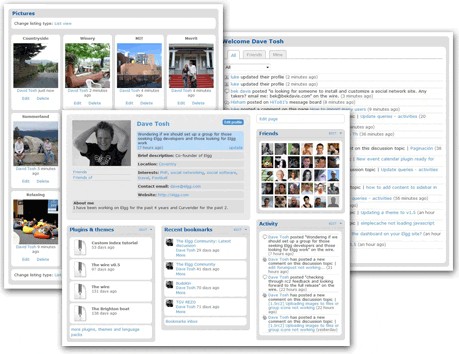
Elgg is free and open source social networking platform that powers all kinds of social environments, from a campus wide social network for your university, school or college or an internal collaborative platform for your organization through to a brand-building communications tool for your company and its clients.

If you are looking to create your own social application, want to build and run a site for your organization, or introduce a social layer into your technology stack, Elgg is a great choice.
Elgg provides the components you need to build a fully-featured social environment, including:
  • Profiles
    Elgg comes with default profile fields that can be extended or completely customized by the site administrator.
  • Activity Streams
    The granular activity stream feature ensures you keep up to date with all site activity.
  • Blogging / Microblogging
    Blogging and microblogging functionality that is both powerful, yet simple to use.
  • Groups
    Collaborate around specific topics via public, private or hidden groups.
  • Access controls
    Control who can access your content.
  • Web Services API
    Expose functionality through the REST API by building a plugin and then either publish the API for other developers to build clients or provide your own.

Mahara, Open source to Build a Social Networking System

Mahara is a fully featured open source electronic portfolio, weblog, resume builder and social networking system, connecting users and creating online communities. Mahara provides you with the tools to create a personal and professional learning and development environment.

What makes Mahara different from other ePortfolio systems is that you control which items and what information (Artefacts) within your portfolio other users see.

In order to facilitate this access control, all Artefacts you wish to show to other users need to be bundled up and placed into one area. Within Mahara this compilation of selected Artefacts is called a View.

You can have as many Views as you like, each with a different collection of Artefacts, and intended purpose and audience. Your audience, or the people you wish to give access to your View, can be added as individuals or as a member of a Group or Community.

ePortfolio owners create Views using a 4 step process and Views have the following features:
  • ePortfolio owners can receive public or private feedback on their View and Artefacts within that View.
  • Users accessing a View can report any objectionable material directly to the Site Administrator.
  • Users can add Views and Artefacts within a View to their Watchlist and receive automated notifications of any changes or updates.
  • ePortfolio owners can Submit a View for Assessment by a tutor or teacher allowing for a snapshot of the View and associated Artefacts on a certain date.
Downloads

Fritzing, go from physical prototyping to actual product

Fritzing is an open-source initiative to support designers, artists, researchers and hobbyists to take the step from physical prototyping to actual product.

Aimed at those basing their projects around Arduino, you start by building your physical prototype, then recreate it with Fritzing software’s graphical editor. From there you can generate a schematic, PCB artwork, and PCB layout for manufacturing.

If you wish to build robust prototypes, to bring your ideas into serial production and to join an enthusiastic emerging community, this is the place to get started...

Sharetronix Platform, an opensource Multimedia Micro-Blogging

Sharetronix Opensource is a multimedia microblogging tool or platform which helps people in a community, company, or group to exchange short messages like discussion, sharing media, status messages etc. from all over the Web.

With Sharetronix users can communicate using quick status updates of 160 characters or less. This free flowing dialogue lets you send messages, pictures and video to anyone! It`s also easy to find and connect with other people for private threads and to keep track of their updates. All this and more in a simple interface.

Sharetronix powers more than 1.5K micro-social communities available in 12 languages across 74 countries. If you loved this and looking for more additional features, then they even have a professional version called BlogtronixMicro.

The main features of BlogtronixMicro includes:

User Profiles
Users on blogtronixMicro have custom profiles with detailed information about them, plus theis activity on the network, groups, personal tags and more.

Status Updates
Every network member can post short and frequent status updates, ask questions, share media and lots more. Blogtronix Micro supports link, video, image and file attachments with posts.

Real-Time Dashboard
On the platform's dashboard users can follow all updates from their connections in the networks in real time. Users can also see who's online, the currently trending post tags and a lot more.

Groups
Create unlimited private or open groups to organize your content and make it easier for everybody to follow topics and conversations. Users with similar interests can connect with each other in groups.

Multimedia
Now you can share more than just text. You can attach links, pictures, videos and other files to your posts. Multimedia attachments make your newtork much more attractive and addictive to users.

Content Tagging
Tag your messages with hashtags to make them easily searchable. Users can also save their favourite tags to be easily accessed later directly from their dashboard.

RSS Aggregation
Automatically import content from RSS/Atom feeds to your profile or groups. Imported feeds can be filtered, so only the interesting stories get published in your network.

Mobile Version
Your microsocial network now fits in your pocket. Our simplified mobile version makes it easy for your network's user stay intouch with each other any time anywhere!

Customization
Your networks features and design are customizable. You can edit the settings and change the logo of your network.

Stealth Mode
When stealth mode is enabled all the links "Powered by BlogtronixMicro" dissapears. This means nobody will know your network is not developed in your company.

Statistics
Our advanced stats module shows you how active your networks users are. Keep track on important parameters of your network's evolution, like how many posts per day you have, etc.

SEO Friendly
blogtronixMicro is SEO optimized and your content will be easily indexed by Google and other search engines. The frontend code is written by all latest standards.

For those interested in this platform, can be download here.

Strobit Wireless Widget Open Hardware Project

Strobit looks like it could be a project to keep an eye on. The entire project is open source, including the hardware. The aim is to build a low cost, low power, wireless enable arduino powered widget. This seems like it could really cut down on the development time of many projects we’ve seen here. Development is still ongoing but it looks like they’ve already implemented some mesh networking similar to the zigbee systems.


Solar powered Widget board, a start for a self contained wireless sensor node

Single 3.6v 0.2w Solar Cell

Wireless Widget (Wireless Freeduino) Open Hardware Project code.google.com/p/strobit